Umami in your kitchen
It is in tomatoes, cheese, fish… in many everyday foods. See where to find the fifth basic taste.

Idioma
Idioma
As soon as summer starts, headlines begin to push the so-called “ideal body” that you could supposedly achieve easily, so you won’t feel embarrassed at the beach. Let’s be honest: behind this so-called friendly advice lies real violence against your self-esteem, especially if you are a woman.
The consequences are huge: eating disorders are the third most common chronic illness among adolescents, and still, only 2% of women worldwide are satisfied with their bodies. For Naiá Ortelan, nutritionist and Master of Science at the University of São Paulo, the spread of these aesthetic standards encourages highly restrictive diets. “Programs that eliminate certain foods and emphasize others are nutritionally unbalanced, which can lead to nutritional deficiencies and serious health issues.”
A healthy body is very different from “ideal curves.” Being healthy means having good health. The so-called “perfect body” is just a hoax to sell magazines or generate clicks. This article was written to share healthy tips for those seeking more toned muscles, without prohibitions or chasing after unrealistic standards.
If you’re one of those who avoid physical exercise, it’s time to change that mindset. Besides all the health benefits, muscle only develops when it undergoes microtraumas caused by physical activity. That soreness after a workout? It’s a sign your muscle was “injured.”
It may sound strange, but these microtraumas are what make you stronger. Since muscle is one of the tissues with the highest plasticity and regeneration, when it’s damaged, it rebuilds even stronger, adapting to different stimuli imposed by the body. Over time, muscles harden and become more tolerant, which is why you need to increase training intensity if you want to keep progressing. If you only want to maintain your current form, keeping the same workout routine is enough.
Now, what many people forget: for defined muscles, eating is essential! “Around 70% of muscle mass comes from nutrition and rest, while the remaining 30% comes from strength training,” explains Naiá.
Of course, diet must align with your workouts, not just an uncontrolled intake of sweets and fried foods. “There is consensus that physical performance capacity is directly related to a balanced intake of all nutrients: carbohydrates, fats, proteins, minerals, vitamins, fiber, and water. Therefore, a diet is recommended that provides 55–60% of total energy from carbohydrates, 25–30% from lipids (fats), and 12–15% from proteins,” Ortelan adds.
Nutrition for physical performance must happen both before and after workouts. Skipping food before training lowers blood pressure, causing dizziness or fainting. On the other hand, starting a workout with a full stomach may cause indigestion, nausea, or even vomiting. “The recommendation is to eat around 45 minutes before exercising,” Naiá advises.
Breakfast before physical activity: Choose high-glycemic index carbs such as bread, plain cake, banana, orange juice, watermelon, honey, granola, or dried fruits. Avoid protein-rich foods like milk, cheese, yogurt, and also fats, to prevent digestive discomfort.
Lunch or afternoon snack before physical activity: Choose low-glycemic index carbs that take longer to digest. “Opt for whole-grain bread, brown rice, sweet potato, fruit salad, yogurt, or açaí with cereals such as golden flaxseed, oats, or royal quinoa,” Naiá suggests.
During training: Hydration is key—drink about 150 mL of water every 20 minutes.
Post-workout nutrition: The best moment to eat is within 30 minutes after exercise to maximize protein synthesis and stop proteolysis (protein breakdown). “This means that what you eat half an hour after training won’t turn into extra calories but will instead be used for muscle recovery,” Ortelan explains. That’s the time to focus on proteins—umami-rich foods.
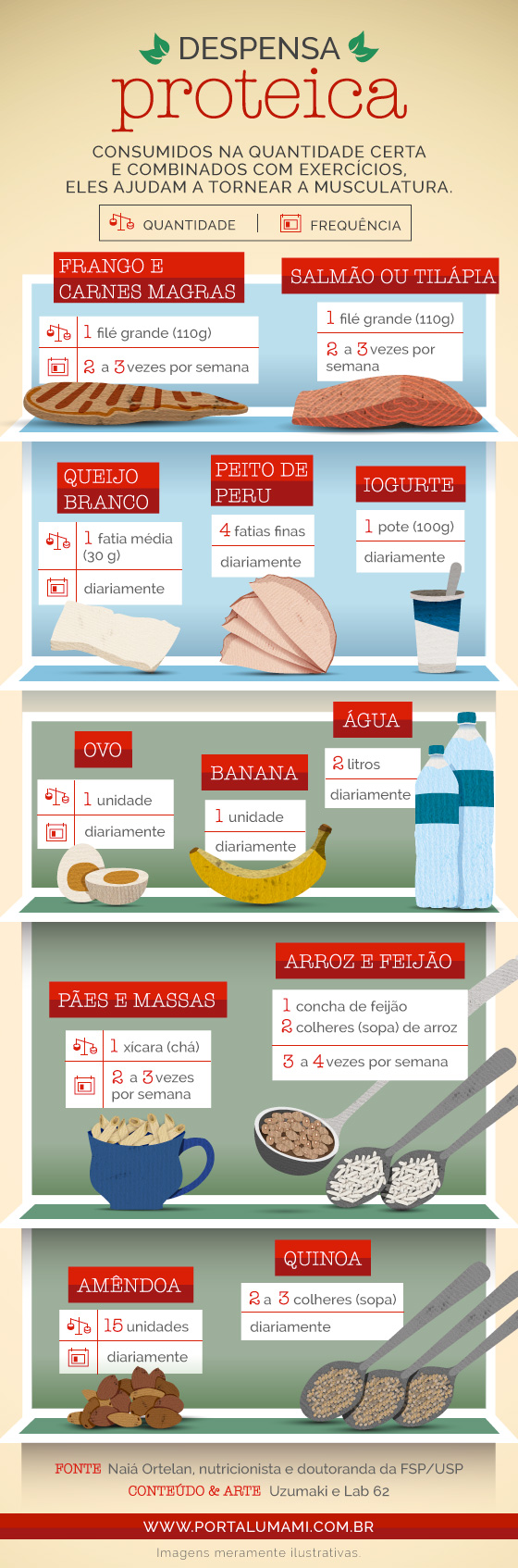
Here are 12 foods that will help you gain muscle mass. Most belong to the protein group, rich in umami, but carbs also play their role. Remember: these tips help, but do not replace professional guidance from a nutritionist!
Chicken and lean meats: Animal-based proteins are considered the best for muscles. Not to mention that they are umami, meaning that in addition to being good for muscle building, they are also tasty. Skinless chicken is a good option for those who want to boost their diet with protein without putting their heart at the mercy of cholesterol and saturated fats, which are present in greater quantities in other meats. To give you an idea, a 110g fillet has 32g of protein and almost no fat. If you’re not a big fan of poultry, opt for lean cuts (top round, bottom round, sirloin) of red meat.
When to eat: after physical activity.
Salmon/tilapia: In addition to being high in protein (and quite umami!), salmon and tilapia fillets are a good source of omega-3, a fat that helps fight the inflammatory processes caused by exercise, facilitating muscle recovery. These two types stand out, but you can vary with other types of fish, including tuna.
When to eat: after physical activity.
Egg: It used to be on the list of “villains” of nutrition, but that’s all in the past when studies proved its excellent ability to strengthen muscles and control good cholesterol. Rich in albumin, a high biological value protein (containing essential amino acids in appropriate proportions), it’s great in its entirety: the yolk, in addition to being protein-rich, contains vitamin B12, necessary to lower fat levels and help with muscle contraction. The egg white is very rich in albumin, a protein made up of easily absorbed amino acids.
When to eat: after physical activity.
Pechuga de pavo: Es rica en proteínas, pero no podemos olvidar que pertenece a la familia de las carnes procesadas. Aunque tiene un menor contenido de grasas saturadas y colesterol, está llena de sodio, lo que favorece la retención de líquidos. Al encontrarse fácilmente en barritas y snacks, es una excelente opción proteica para quienes necesitan un refrigerio rápido.
Cuándo comer: después de la actividad física.
Queso: Uno de los alimentos con más umami que existen, el queso concentra proteínas y calcio, un mineral esencial para la contracción muscular y los huesos. También es rico en magnesio, un mineral que ayuda a mantener activos los compuestos que nos proporcionan energía.
Cuándo comer: después de la actividad física.
Yogur natural: Con un sabor umami considerable, lo que lo hace aún más sabroso, es un alimento crucial para el crecimiento muscular porque combina proteínas y carbohidratos en dosis ideales. Una taza aporta el 10% de nuestras necesidades diarias de proteínas y es una buena fuente de calcio. Añadir fruta (que es un carbohidrato) es aún mejor, ya que aumenta los niveles de insulina, una de las claves para reducir la pérdida de proteínas que suele producirse tras la actividad física. Opte por la versión sin azúcar ni edulcorantes. Ambas reducen la actividad de los lactobacilos, beneficiosos para el funcionamiento intestinal, y el contenido de vitaminas del complejo B.
Cuándo consumir: después de la actividad física.
Beans and rice: Every Brazilian likes it, and they don’t always know why this partnership is so perfect. The amino acids in beans complement those in rice. Together, they are great for repairing muscles. Rice is also a source of carbohydrates, which provides important energy for the muscle recovery process (choose brown rice, which has fiber and complex carbohydrates), while beans are rich in vegetable protein, iron, and minerals.
When to eat: after physical activity.
Breads and pasta: Many muscle-building diets restrict this class because they belong to the carbohydrate group, but cutting them out is a big mistake. Although they don’t directly contribute to muscle hardening, they provide energy when working out. Without them, the body will seek the necessary fuel to have energy from other sources. And where does it find this fuel? In proteins. In other words, the macromolecule divides its function of recovering muscles with that of providing energy, not being 100% utilized. But don’t overdo it, as carbohydrates can be stored in the body as fat. Opt for whole-grain versions, because they have more fiber, are more satiating, and release energy gradually.
When to eat: before physical activity.
Quinoa: Each 100g of quinoa contains 15g of protein, 68g of carbohydrates, 9.5mg of iron, 286mg of phosphorus, 112mg of calcium, 5g of fiber, and 335 kcal. The composition may vary slightly due to the diversity of seeds, but in any case, it’s a good balance. With the advantage of having little fat, it helps repair damage caused by physical exercise, strengthening the muscles worked.
When to eat: after physical activity.
Banana: Following the idea of consuming carbohydrates before training, eat a banana a few minutes before working out. It’s a great option because it has potassium, a mineral that participates in the production of glycogen (muscle energy reserve) and also prevents cramps.
When to eat: before physical activity.
Almonds: They help prevent damage caused by free radicals after training, and the less damage the body receives from free radicals, the faster the muscles will recover.
When to eat: after physical activity.
Water: Even muscles need water. About 80% of our muscle mass is made up of this sacred liquid. “A study conducted in Germany shows that the more dehydrated your body is, the more slowly it will use protein to build muscle,” explains the nutritionist. In other words, protein synthesis happens more easily when cells are well hydrated. When the muscle is dehydrated, fatigue sets in quickly and performance will decrease.
When to drink: before, during, and after physical activity.