
Glycemic Index of Umami Foods
Autor(a):
Hellen Dea Barros Maluly (MALULY, H.D.B.)
Pharmacist and PhD in Food Science
Address to access this CV: http://lattes.cnpq.br/2754275781355863
Published on: 28 de October de 2021
Resumo
One of the major concerns of science relates to the control of non-communicable chronic diseases such as diabetes, obesity, among others. In this context, nutritionists have developed strategies to reduce the consumption of foods rich in salt, sugar, and fat, which are closely linked to increases in glycemic indices, cholesterol, and other markers important for the development of these diseases. Regarding sugar consumption, theories related to the glycemic index of foods have been developed. Some foods that have the umami taste also contain digestible carbohydrates, and awareness of studies on this topic is important to evaluate the best diet for diabetic individuals—always remembering that food variety and a proper, flavorful diet can improve their quality of life.
Palavras-chaves: glycemic index; diabetes; umami
In recent times, health professionals and governmental bodies have increased alerts regarding the risks associated with high consumption of foods rich in salt, sugar, and fat. This has been occurring due to the rising incidence of cases of non-communicable chronic diseases (e.g., obesity, overweight, hypertension, and type II diabetes) affecting part of the world population (Brazilian Society of Diabetes, 2021). One of the diseases mentioned is type II diabetes, a metabolic disease characterized by hyperglycemia* and insulin resistance.
Insulin is a hormone produced by the pancreas, responsible for promoting the entry of glucose into cells for energy generation. In type I diabetes, insulin is produced in very low amounts due to the autoimmune destruction of pancreatic cells. In type II diabetes, insulin is produced, but it has a reduced biological response, failing to adequately transport glucose to target organs, which characterizes insulin resistance (Brazilian Society of Diabetes, 2021).
The main symptoms of diabetes are: excessive urination, excessive thirst, increased appetite, weight loss (in obese individuals, weight loss occurs even when eating excessively), fatigue, blurred or cloudy vision, and frequent infections, most commonly skin infections. To minimize one of the symptoms of diabetes, it is recommended to avoid the consumption of foods with a high glycemic index.
The glycemic index classifies different types of foods containing carbohydrates according to the speed at which sugars reach the bloodstream. To promote a healthy diet, the FAO/WHO expert committee recommends a diet with carbohydrates (55–75% of total energy), including sources that also come from non-starch polysaccharides, which are rich in fiber and have a low glycemic index (GI ≤ 55), considering that their contribution to total energy intake will vary from country to country based on consumption patterns and food availability (FAO, 1998; WHO, 2003; Wolever et al., 2008).
GI is measured by the increase in glucose under the glycemic curve caused by the ingestion of a 50 g portion of a food, expressed as a percentage of the area under the glycemic curve produced by the same amount of carbohydrate present in a standard food**. For example, bananas raise blood glucose levels more than apples, even though both fruits have the same total carbohydrate concentration. Cooked sweet potatoes raise glucose levels more than cooked carrots (Henriques, 2012).
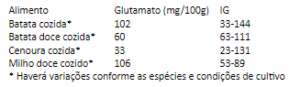
However, if you think that a diet based on low glycemic index foods lacks flavor, you are mistaken! There are some foods that contain glutamate in their composition and provide the delicious umami taste. Examples are shown in the table below (Umamiinfo, 2021; Foster-Powell et al., 2002).

On the other hand, there are still some controversies regarding this recommendation. A study published in 2014 revealed that diets using low glycemic index carbohydrates, when compared to those with intermediate or high glycemic index, did not result in improvements in risk factors for cardiovascular disease or insulin resistance in the studied population. The study also indicates that individuals who already have a healthy diet and practice physical exercise should not be overly concerned with the glycemic index of foods, especially because, depending on the activity performed, there is a need for intermediate glucose absorption. Umami foods that have this characteristic are (Sacks et al., 2014; Umamiinfo, 2021; Foster-Powell et al., 2002).
As there are several studies and relevant discussions about the glycemic index, it is still not possible to determine exactly what would be best and most feasible for the general population, since this will depend on individual, cultural, and socioeconomic aspects. Therefore, what nutritionists always recommend is a varied, balanced, and, of course, flavorful diet, which can be achieved with a mix of foods that have the delicious umami taste!
*Hyperglycemia: high levels of glucose — sugar — in the blood
**Glycemic Index: the “standard” food used to calculate GI is white bread (GI = 100). Based on this value, food GI is classified as: High GI (≥ 63); Low GI (≤ 55); Intermediate GI (≥ 59 and ≤ 63).
References
- SOCIEDADE BRASILEIRA DE DIABETES. 2021. Disponível em: https://diabetes.org.br/. Acesso em: 13/10/2021.
- FAO. Carbohydrates in Human Nutrition. Report of a Joint FAO/WHO Expert Consultation (FAO Food and Nutrition Paper 66) Food and Agriculture Organization: Rome, 1998.
- WHO. Diet, Nutrition and the Prevention of Chronic Diseases. Report of a Joint WHO/FAO Expert Consultation (WHO Technical Report Series 916) World Health Organization: Geneva, 2003.
- WOLEVER, T.M., GIBBS, A.L., MEHLING, C., CHIASSON, J.L., CONNELLY, P.W., JOSSE, R.G., LEITER, L.A., MAHEUX, P., RABASA-LHORET, R., RODGER, N.W., RYAN, E.A. The Canadian Trial of Carbohydrates in Diabetes (CCD), a 1-y controlled trial of low-glycemic-index dietary carbohydrate in type 2 diabetes: no effect on glycated hemoglobin but reduction in C-reactive protein. American Journal of Clinical Nutrition, v. 87, n. 1, p.:114-25. 2008
- HENRIQUES, G.S. Biodisponibilidade dos carboidratos. In: COZZOLINO, S. M. F. (Org.) . Biodisponibilidadede Nutrientes (4ª edição atualizada e ampliada). v. 1.; 4. ed. Barueri, São Paulo: Editora Manole Ltda, 2012. 214-223p.
- FOSTER-POWELL, K., HOLT, S.H.A., BRAND-MILLER, J.C. International table of glycemic index and glycemic load values: 2002. American Journal of Clinical Nutrition,v. 76, p5–56. 2002
- SACKS, F.M., CAREY, V.J., ANDERSON, C.A., MILLER, E.R., COPELAND, T., CHARLESTON, J., HARSHFIELD, B.J., LARANJO, N., MCCARRON, P., SWAIN, J., WHITE, K., YEE, K., APPEL, L.J. Effects of high vs low glycemic index of dietary carbohydrate on cardiovascular disease risk factors and insulin sensitivity: the OmniCarb randomized clinical trial. JAMA,v. 312, n. 23, p.2531-41, 2014.
Related materials

- Articles
Umami Taste and Breastfeeding in the First Months of Life

- Articles
The Importance of Glutamate and Glutamine for the Infant Gut

- Articles
The Behavior of Glutamate in the Gastrointestinal Tract

- Articles